Understanding Different Types of Transformers
Transformers are foundational components of electrical power grids, enabling the safe and efficient transmission and distribution of electrical energy across industrial, commercial, and residential sectors. Operating on the principle of electromagnetic induction, a transformer steps voltage levels up or down with minimal energy loss—for instance, stepping down high transmission voltages (400 kV or 20 kV) to utilization levels (400 V / 230 V).
Because electrical power applications vary widely across generation, transmission, distribution, and industrial processing, transformers are engineered in several distinct classifications. In this article, we comprehensively examine transformer classifications based on function, cooling system, installation location, number of phases, and core construction.
Main Classifications of Electrical Transformers
Electrical power undergoes multiple voltage transformations from the power plant to the end user. Consequently, transformers are categorized according to five primary engineering criteria:
- By Function / Application: Distribution transformers, power transformers, instrument transformers, etc.
- By Installation Location: Pad-mounted (ground) vs. pole-mounted (overhead) transformers
- By Number of Phases: Single-phase vs. three-phase transformers
- By Cooling & Insulation Medium: Oil-immersed vs. dry-type transformers
- By Magnetic Core Geometry: Core-type vs. shell-type transformers
Note that a single transformer belongs to multiple categories simultaneously—for example, a three-phase, oil-immersed, pad-mounted distribution transformer.
1. Classification by Function
- Distribution Transformers: Positioned at the final stage of the electrical distribution network, these units step down medium voltage (typically 20 kV or 33 kV) to low voltage (400 V / 230 V) for residential, commercial, and light industrial consumers. They are smaller in size than power transformers but are deployed in vast numbers across urban and rural grids.
- Power Transformers: Installed in power generation stations and high-voltage transmission substations, power transformers operate at high capacities (above 10 MVA) and high voltages (63 kV, 132 kV, 230 kV, and 400 kV) to step up generator voltage for long-distance transmission with minimal line loss.
- Instrument Transformers (CT & PT/VT): Used in AC power systems for accurate metering and protective relaying in high-voltage circuits. Current Transformers (CT) step down high primary currents to standardized low values (1 A or 5 A), while Potential/Voltage Transformers (PT/VT) step down high voltages to safe metering levels (e.g., 100 V or 110 V).
- Welding Transformers: Specialized step-down transformers designed for industrial electric arc welding. They step mains voltage (230 V / 400 V) down to a safe low open-circuit voltage (20–50 V) while supplying very high secondary currents (hundreds of amperes) required to strike and sustain a welding arc.
- Isolation Transformers: Engineered with a 1:1 turns ratio to provide complete galvanic isolation between primary and secondary circuits without changing voltage levels—protecting sensitive medical, laboratory, and control equipment against ground loops, surges, and electrical noise.
2. Classification by Cooling and Insulation System
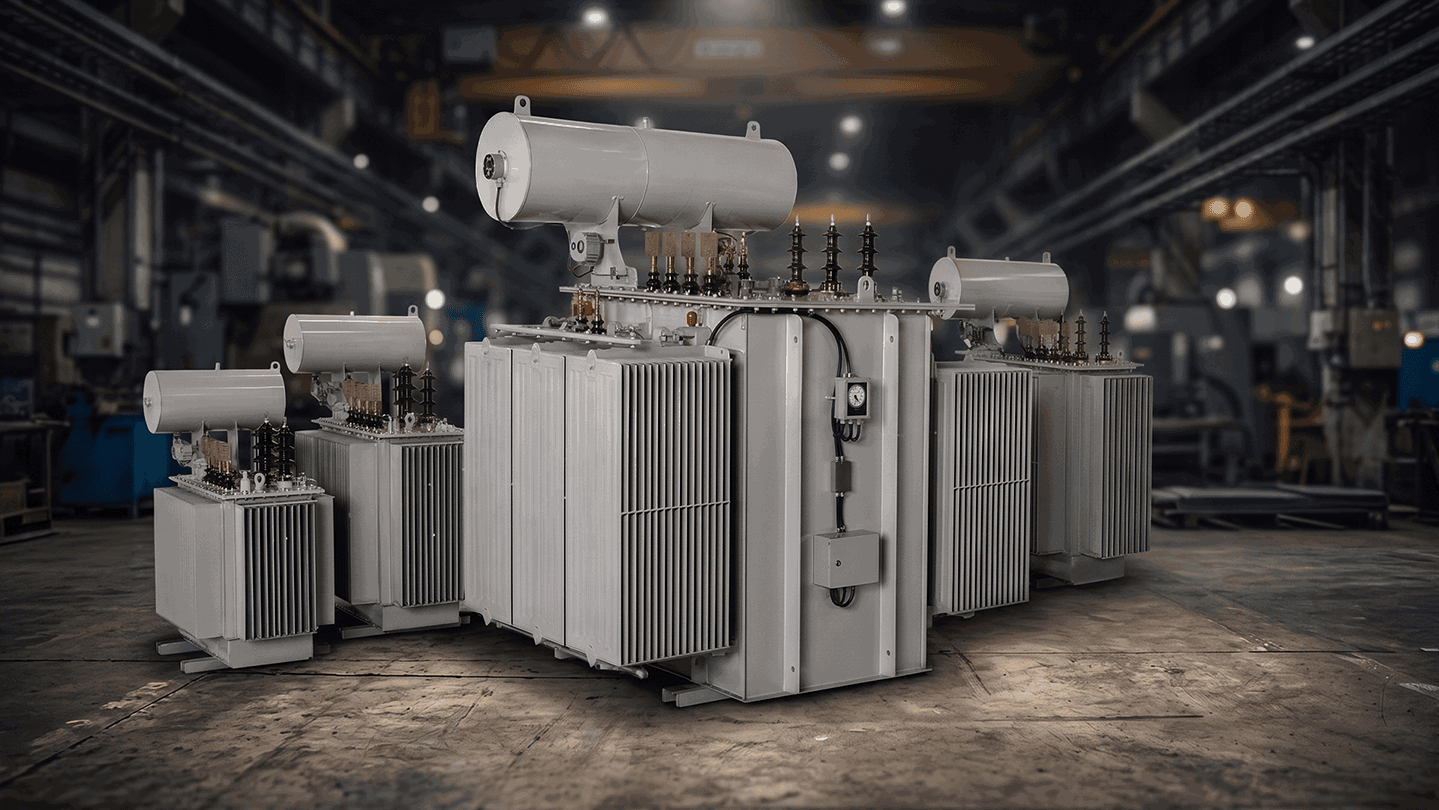
- Oil-Immersed Transformers: The most widely used design in utility and industrial applications, utilizing refined mineral oil or natural/synthetic ester fluids for both dielectric insulation and convective heat dissipation. Oil-immersed units are subdivided into conservator-type and hermetically sealed models.
- Dry-Type Transformers: Instead of dielectric oil, dry-type transformers use air circulation or cast epoxy resin to insulate and cool the windings. Because they pose minimal fire or oil-spill hazard, they are preferred for indoor installations such as hospitals, high-rise buildings, underground metro stations, and residential complexes.
3. Classification by Installation Location
- Pad-Mounted (Ground) Transformers: Installed on concrete foundations inside substations, kiosks, or protective enclosures, serving medium-to-high capacity urban and industrial loads.
- Pole-Mounted (Overhead) Transformers: Compact, lighter-weight distribution transformers (typically 25 kVA to 315 kVA) mounted directly on utility poles in rural areas, agricultural networks, and low-density districts.
4. Classification by Number of Phases
- Single-Phase Transformers: Used for light residential loads, rural feeders, and single-phase commercial applications where three-phase power is unnecessary.
- Three-Phase Transformers: The standard backbone of industrial facilities and utility transmission/distribution networks, offering superior power density, efficiency, and balanced three-phase power delivery.
5. Classification by Core Construction
- Core-Type Transformers: Primary and secondary windings are wound concentrically around two or तीन vertical core limbs, with magnetic flux circulating through a rectangular yoke path. This geometry offers excellent cooling and high-voltage insulation clearance, making it standard for distribution and power transformers.
- Shell-Type Transformers: The windings are placed on a central limb and completely surrounded by the outer magnetic core return paths, providing high mechanical bracing and symmetrical flux distribution for specialized low-voltage/high-current applications.
Conclusion
Understanding transformer classifications across function, cooling medium, mounting arrangement, phase configuration, and core geometry is essential for selecting the optimal equipment for any electrical infrastructure project—maximizing energy efficiency, operational safety, and asset longevity.
Frequently Asked Questions (FAQ)
1. What are the most common functional types of transformers?
Power transformers, distribution transformers, instrument transformers (CT and PT), isolation transformers, and welding transformers are the most widely used types.
2. What is the main difference between oil-immersed and dry-type transformers?
Oil-immersed transformers use dielectric liquid for cooling and insulation and excel in outdoor and high-capacity applications, whereas dry-type transformers use air or cast resin and are suited for indoor, fire-sensitive environments.
3. Is a single-phase or three-phase transformer better?
It depends on the load: single-phase units suffice for small rural or residential loads, whereas three-phase transformers are essential for industrial plants and main distribution grids.
4. Why is choosing the right transformer category important?
Proper selection maximizes equipment service life, reduces no-load and load energy losses, and optimizes capital and operating costs across the power network.